Sri Lanka fuel prices just jumped 35% because of the Middle East war. See the full breakdown of new petrol and diesel prices for March 2026 — and what comes next.
The war thousands of miles away is now hitting your fuel tank, your grocery bill, and your daily commute. Here is everything you need to know.
A War Far Away Creates a Crisis Right Here
When missiles fly over the Middle East, most Sri Lankans do not feel the impact immediately. But this time, the shockwave arrived fast — and it hit at the fuel pump.
Fuel prices in Sri Lanka surged by around 35% following the outbreak of the Middle East conflict, with increases implemented in two separate revisions by the Ceylon Petroleum Corporation (Ceypetco).
That is not a small number. A 35% jump in fuel prices means a harder life for tuk-tuk drivers, bus riders, farmers, fishermen, and families who cook with kerosene. It means higher prices at the market, costlier school runs, and more pressure on a country that is still recovering from one of its worst economic crises in modern history.
So what exactly happened? How did a conflict in the Middle East empty wallets in Tangalle, Kandy, and Jaffna? And what does the government plan to do about it?
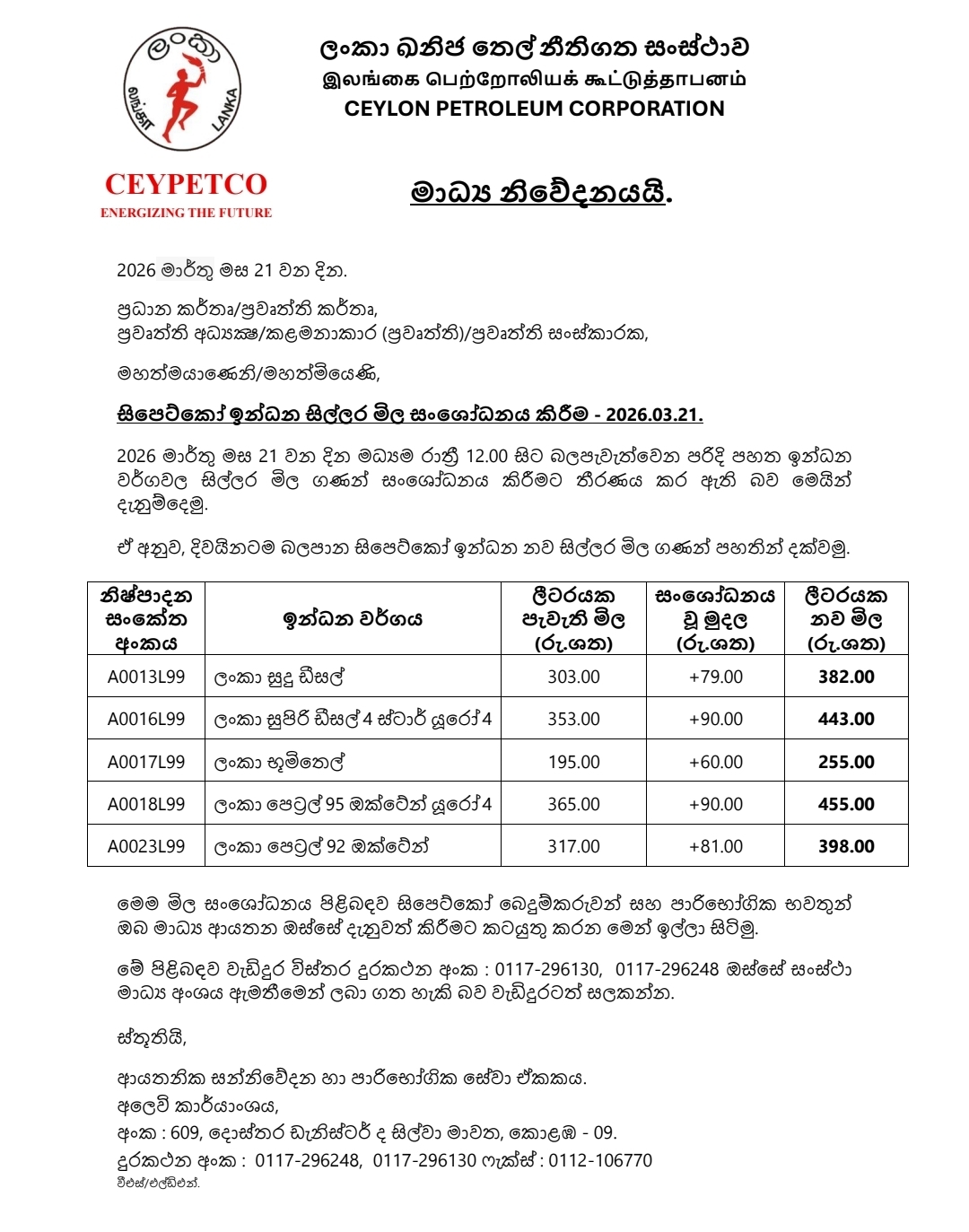
The Numbers: What You Pay Now vs. What You Paid Before
Let us start with the hard facts. Two price revisions happened in quick succession — one on March 9, 2026, and the latest one effective from midnight on March 21–22, 2026.
After both revisions combined, here is where prices now stand for CPC and Lanka IOC customers:
Petrol 92 Octane — Rs. 398 per litre (up Rs. 105 since March 9) Petrol 95 Octane — Rs. 455 per litre (up Rs. 115) Auto Diesel — Rs. 382 per litre (up Rs. 101) Super Diesel — Rs. 443 per litre (up Rs. 114) Kerosene — Rs. 255 per litre (up Rs. 60)
Sinopec, the Chinese-owned private fuel supplier operating in Sri Lanka, went even further. Sinopec increased its Petrol 95 Octane price to Rs. 487 per litre and set Super Diesel at Rs. 572 — both significantly above the CPC rates, reflecting the full market cost of importing fuel today.
Sri Lanka raised fuel prices by 25% on Sunday — the second increase in two weeks — as the country prepared for more impact from the war in the Middle East. The March 9 revision had already pushed prices up by around 8%, so the combined effect is now being felt sharply by ordinary people.
Why Did This Happen? The Strait of Hormuz Holds the Answer
To understand why your petrol now costs Rs. 398, you need to look at a narrow stretch of water called the Strait of Hormuz.
The Strait of Hormuz, a key waterway through which about 20% of global oil exports pass in peacetime, has been effectively closed by Iran in retaliation over the US and Israeli war against it, now entering its fourth week.
When that waterway shuts down — even partially — global oil markets panic. Traders worry about supply. Prices shoot up. And countries that import all of their oil, like Sri Lanka, absorb every dollar of that increase.
UN estimates indicate oil prices have risen by around 45% and gas by 55% since late February, with fertilizer prices up 35%.
President Anura Kumara Dissanayake explained this mechanism bluntly in Parliament. He stated that crude oil prices have increased from $81 to $114 — a 40% rise — and that for every one-dollar increase in global oil prices, domestic fuel prices must rise by Rs. 2.
That formula makes the math unavoidable. When global oil jumps by $49, Sri Lankan diesel prices must follow. There is no escape from that arithmetic for an island nation that produces zero oil of its own.
Sri Lanka Is in a Uniquely Vulnerable Position
Sri Lanka imports all of its oil and also buys coal for electricity generation. It buys refined petroleum products from Singapore, Malaysia, and South Korea, while crude oil for its Iran-built refinery is sourced from the Middle East.
This means Sri Lanka sits at the end of a very long and fragile supply chain. Every disruption in the Persian Gulf travels directly to Colombo. Two expected crude oil shipments of 90,000 metric tonnes each were already delayed, raising urgent concerns about supply continuity.
In Sri Lanka, where petroleum accounts for about a quarter of total imports, authorities introduced fuel rationing and cut back public events to conserve supplies. Schools shifted to a four-day week, while public sector operations were scaled down.
The President went further — he ordered a four-day working week and asked employers to reintroduce work-from-home arrangements wherever possible. The goal: cut fuel consumption by 15% to 20% and stretch existing reserves as far as possible.
The Private Sector Complicates the Picture
Here is where the story gets more complicated. Sri Lanka’s fuel market is no longer entirely run by the government.
President Dissanayake told Parliament that the Ceylon Petroleum Corporation currently supplies 57% of the country’s fuel requirements. The remaining 43% comes from private companies — Sinopec, Lanka IOC, and others.
Private importers face a brutal reality. They buy fuel at current global prices, ship it to Sri Lanka, and then sell it at whatever retail price the government sets. When global prices shoot up but the retail price stays fixed, they lose money — massively.
The President acknowledged that private companies reportedly incur a loss of approximately USD 55 million per shipment at current price levels — a figure he described as completely unsustainable. Their message to the government is stark: either let us charge market rates, or we stop importing.
This matters enormously. If private suppliers exit the market, CPC alone cannot cover national demand. Fuel shortages — like the nightmare scenes of 2022, with hours-long queues and stations running dry — could return.
What the Government Is Doing
The government is threading a needle between two painful options: keep prices low and risk supply collapse, or raise prices and hurt millions of struggling families.
The government warned that the fighting in the Middle East, and a prolonged war, could seriously undermine its efforts to emerge from the economic meltdown of 2022. Sri Lanka defaulted on its $46 billion foreign debt in 2022 after the country ran out of foreign exchange.Since then, the country has been working through a $2.9 billion IMF bailout and cannot afford another economic freefall.
The President stressed in Parliament that the issue of fuel pricing must be addressed urgently, and that necessary legislative amendments to allow private companies to price fuel more flexibly are still being finalized.
Meanwhile, the QR code fuel quota system — already in place — has been revised to balance rationing with practical daily needs. Weekly allocations now stand at 25 litres for motorcars, 8 litres for motorcycles, 20 litres for three-wheelers, 100 litres for buses, and 50 litres for vans.
The Human Cost: What This Means for Real Families
Abstract numbers in Parliament debates become very concrete when you fill your tank or pay your fare.
Higher fuel prices are already pushing up transport, production, and food costs, hitting poorer households hardest. Regional inflation could rise to 4.6% in 2026, up from 3.5% in 2025.
A tuk-tuk driver now spends significantly more per day just to keep moving. A vegetable seller’s transport costs rise, and so does the price of tomatoes on your plate. A family using kerosene for cooking sees their weekly household budget stretched further than it has been in years.
The pattern is familiar and cruel: global shocks always land heaviest on the people with the least cushion to absorb them.
Is More Bad News Coming?
Yes — possibly. The President made clear in Parliament that more adjustments may follow if global prices continue climbing. He noted that while global fuel prices have risen by as much as 49%, the domestic increase so far has been limited to around 35% — meaning Sri Lankan consumers have actually been partially shielded from the full market impact.
ESCAP warns that growth across developing Asia-Pacific economies could slow to around 4.0% in 2026, down from 4.6% in 2025, with poverty, food insecurity, and inequality potentially worsening alongside job losses.
Sri Lanka, still climbing out of a debt crisis, can ill afford those outcomes.
What You Should Know and What You Can Do
The fuel price situation is serious, but it is not without context or hope. Here are the key takeaways every Sri Lankan should understand right now:
The price increases are driven by a real global supply shock, not just government policy choices. The Middle East conflict directly controls the cost of oil on world markets, and Sri Lanka has no oil of its own to fall back on.
The QR quota system gives every vehicle owner a baseline weekly allocation — use it strategically and plan your travel to cut unnecessary trips.
Work-from-home, carpooling, public transport, and cycling are not just government suggestions — they are genuinely effective ways to reduce your personal fuel spending right now.
Expect further price revisions if the conflict continues. Budgeting conservatively for higher transport and food costs over the coming months is wise.
The government is negotiating with private fuel suppliers and working on legislative changes. Whether those efforts succeed in stabilising supply — without another round of painful price hikes — remains the critical question.
The Bottom Line
A war that started far from Sri Lanka has reached every household on this island. The Ceylon Petroleum Corporation official summed up the government’s hope: a 15% to 20% reduction in fuel consumption through the latest price increase. Whether Sri Lankans can absorb these costs while the Middle East conflict drags on — and whether the government can keep fuel flowing — will define this country’s economic story in the months ahead.
Sri Lanka survived 2022. It rebuilt slowly and painfully. The Middle East war is now testing whether that recovery holds.
Why did Sri Lanka’s fuel prices increase by 35% in 2026?
Sri Lanka’s fuel prices surged by around 35% because of the Middle East conflict, which disrupted global oil supply through the Strait of Hormuz — a key waterway carrying about 20% of the world’s oil exports. Since Sri Lanka imports all of its oil and produces none domestically, every rise in global crude prices directly increases what Sri Lankans pay at the pump. The Ceylon Petroleum Corporation’s pricing formula means that for every one-dollar increase in global oil prices, domestic fuel prices must rise by Rs. 2.
What are the current fuel prices in Sri Lanka as of March 2026?
Following the two revisions by the Ceylon Petroleum Corporation (CPC), the current prices are: Petrol 92 Octane — Rs. 398 per litre, Petrol 95 Octane — Rs. 455 per litre, Auto Diesel — Rs. 382 per litre, Super Diesel — Rs. 443 per litre, and Kerosene — Rs. 255 per litre. Sinopec charges higher rates for some grades, including Rs. 487 for 95 Octane and Rs. 572 for Super Diesel, as their pricing reflects full global market costs.
Will Sri Lanka’s fuel prices increase again soon?
Possibly yes. President Anura Kumara Dissanayake warned Parliament that further price adjustments may be necessary if global oil prices continue rising. He noted that while global fuel prices have climbed by as much as 49%, Sri Lanka’s domestic increase has so far been limited to around 35%, meaning consumers have been partially shielded. If the Middle East conflict continues or worsens, another revision cannot be ruled out.
How does the QR fuel quota system work after the March 2026 revision?
The QR code fuel quota system controls how much fuel each vehicle can purchase per week. After the latest revision, motorcars receive 25 litres per week, motorcycles get 8 litres, three-wheelers are allocated 20 litres, buses receive 100 litres, and vans get 50 litres. The quota for lorries and special-purpose vehicles remains unchanged. Vehicle owners should plan their travel carefully to stay within their weekly allocation.
Why are private fuel companies like Sinopec charging more than CPC?
Private fuel importers — including Sinopec and Lanka IOC — buy fuel at current global market prices, which have surged dramatically due to the Middle East conflict. When the government-set retail price does not fully cover their import costs, they lose money on every shipment. The President acknowledged in Parliament that private suppliers reportedly lose around USD 55 million per shipment at below-market prices, which is unsustainable. Sinopec has therefore set its prices above CPC rates to reflect actual landed costs, while Lanka IOC has aligned with CPC pricing for now.