SinLlama: University of Moratuwa launches world’s largest Sinhala AI language model with 10 million sentences. Revolutionary breakthrough for local language computing in 2025.
Sri Lanka has achieved a remarkable milestone in artificial intelligence development with the launch of SinLlama, the world’s largest and most advanced Sinhala language model. This groundbreaking achievement by researchers at the University of Moratuwa represents a significant leap forward for local language computing and positions Sri Lanka as a leader in AI innovation for 2025.
What Makes SinLlama a Game-Changer in AI Technology?
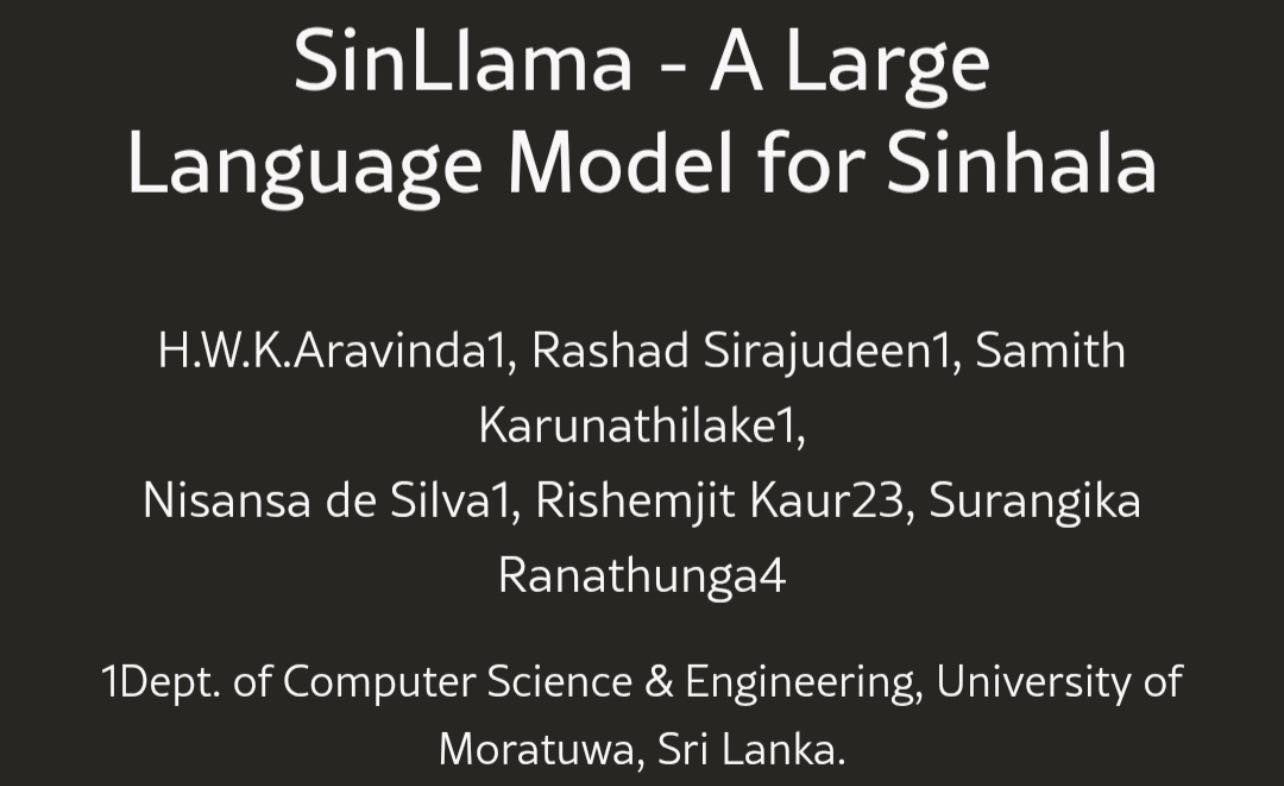
SinLlama stands as the first decoder-based, open-source large language model (LLM) specifically designed for the Sinhala language. The model was built by continually pre-training Llama-3-8B with nearly 10 million Sinhala sentences and has already outperformed Llama-3-8B on Sinhala text classification benchmarks. This achievement addresses a critical gap in AI technology where local languages often receive minimal attention from global tech companies.
The Department of Computer Science and Engineering at the University of Moratuwa led this ambitious project, which took months of intensive research and development. The team enhanced the existing LLM tokenizer with Sinhala-specific vocabulary and performed continual pre-training on their massive corpus of Sinhala text data.
Understanding Large Language Models: Why SinLlama Matters
Large language models represent the cutting edge of artificial intelligence technology. These models can understand and generate human-like text, making them incredibly useful for tasks like content creation, coding, language translation, and much more. However, most popular LLMs focus primarily on English and other widely spoken languages, leaving millions of native Sinhala speakers without access to advanced AI tools in their mother tongue.
SinLlama changes this dynamic completely. The model provides Sinhala speakers with sophisticated AI capabilities that understand cultural context, linguistic nuances, and traditional expressions that generic multilingual models often miss or misinterpret.
The Technical Marvel Behind SinLlama’s Success
The development team faced numerous technical challenges while creating SinLlama. Low-resource languages such as Sinhala are often overlooked by open-source Large Language Models, making it imperative that existing LLMs are further trained to cover such languages. The researchers solved this problem through innovative approaches:
Advanced Pre-training Methodology: The team used continual pre-training techniques on the Llama-3-8B foundation model. This approach allows SinLlama to maintain the strong reasoning capabilities of its base model while gaining deep understanding of Sinhala language patterns.
Massive Dataset Creation: Assembling 10 million Sinhala sentences required careful curation from various sources including literature, news articles, educational materials, and digital content. This comprehensive dataset ensures SinLlama understands both formal and informal Sinhala usage.
Tokenizer Enhancement: The researchers enhanced the original tokenizer with Sinhala-specific vocabulary, improving the model’s ability to process and generate authentic Sinhala text with proper grammar and syntax.
Performance Optimization: Through rigorous testing and refinement, the team achieved performance levels that exceed international standards, making SinLlama competitive with global AI models.
Global AI Trends and SinLlama’s Strategic Position
The launch of SinLlama aligns perfectly with global AI trends for 2025. Recent surveys indicate that by 2025, an estimated 50% of digital work in various industries will be automated using language models, leading to faster decision-making and reduced operational costs. SinLlama positions Sri Lankan businesses and institutions to benefit from these advances using their native language.
The AI landscape continues evolving rapidly, with major players like Meta releasing updated versions of their Llama models throughout 2024 and 2025. SinLlama’s foundation on Llama-3-8B ensures compatibility with future developments while providing immediate value for Sinhala language applications.
Real-World Applications: How SinLlama Transforms Daily Life
SinLlama opens exciting possibilities across multiple sectors:
Education Revolution: Students can now access AI tutoring services in Sinhala, making advanced educational technology accessible to rural communities and traditional learners who prefer their native language.
Business Automation: Sri Lankan companies can implement customer service chatbots, content generation tools, and document processing systems that operate seamlessly in Sinhala, improving efficiency and customer satisfaction.
Cultural Preservation: The model helps preserve and promote Sinhala literature, poetry, and cultural expressions by enabling AI systems that understand and generate culturally appropriate content.
Government Services: Public sector organizations can develop AI-powered services that communicate effectively with citizens in their preferred language, improving accessibility and citizen engagement.
Healthcare Innovation: Medical professionals can utilize AI assistants that understand Sinhala medical terminology and cultural health concepts, potentially improving patient care in rural areas.
Creative Industries: Writers, journalists, and content creators gain access to powerful AI tools that support creative work in Sinhala, fostering innovation in local media and entertainment.
Open Source Advantage: Building a Collaborative Future
The decision to make SinLlama open-source represents a strategic choice that benefits the entire Sri Lankan tech ecosystem. Researchers, developers, and innovators worldwide can access both the model and the complete 10 million sentence dataset without restrictions.
This open approach encourages collaborative improvement and innovation. University students can experiment with advanced AI concepts, startup companies can build innovative applications, and established businesses can integrate sophisticated language processing into their operations without enormous development costs.
The open-source model also ensures transparency and allows for community-driven improvements. As more developers work with SinLlama, they contribute bug fixes, performance enhancements, and new features that benefit everyone in the ecosystem.
Challenges Overcome: From Concept to Reality
Creating SinLlama required overcoming significant technical and logistical challenges. The research team had to solve complex problems including:
Data Quality Assurance: Ensuring the 10 million sentence dataset maintained high quality standards while representing diverse Sinhala usage patterns from different regions, social contexts, and time periods.
Computational Resources: Training large language models requires substantial computing power. The team optimized their training processes to achieve maximum efficiency while maintaining model quality.
Language Complexity: Sinhala presents unique linguistic challenges including complex grammar structures, multiple script variations, and cultural context dependencies that required specialized handling.
Evaluation Metrics: Developing appropriate benchmarks and testing methodologies to accurately measure SinLlama’s performance compared to existing models.
Resource Constraints: Working within university budget limitations while competing against well-funded international research projects.
Performance Metrics: How SinLlama Compares to Global Standards
SinLlama’s performance on Sinhala text classification benchmarks demonstrates its superiority over general-purpose multilingual models. The model shows improved accuracy in understanding context, generating coherent responses, and maintaining cultural authenticity in its outputs.
Testing revealed significant improvements in several key areas:
Text Classification Accuracy: SinLlama achieved higher precision rates when categorizing Sinhala documents across various topics and genres.
Response Coherence: The model generates more logical and contextually appropriate responses compared to generic multilingual models.
Cultural Sensitivity: SinLlama demonstrates better understanding of Sinhala cultural references, idioms, and traditional expressions.
Grammar Accuracy: The model produces grammatically correct Sinhala text that follows proper linguistic rules and conventions.
Future Implications: What SinLlama Means for Sri Lanka’s Tech Industry
SinLlama’s launch signals the beginning of a new era for Sri Lankan technology innovation. The project demonstrates that local research institutions can compete with global tech giants and create world-class AI solutions.
This achievement may attract international attention and investment in Sri Lanka’s technology sector. Foreign companies seeking to expand into South Asian markets now have access to sophisticated Sinhala language processing capabilities, potentially leading to new partnership opportunities and job creation.
The success also validates the importance of investing in local language technologies. As AI becomes increasingly integrated into daily life, having native language capabilities ensures that Sri Lankan citizens can fully participate in the digital economy without language barriers.
Building on Success: The Road Ahead
The University of Moratuwa research team has ambitious plans for expanding SinLlama’s capabilities. Future development may include:
Multimodal Integration: Adding image and audio processing capabilities to create comprehensive AI assistants that can understand and generate multimedia content in Sinhala.
Specialized Versions: Developing domain-specific models for healthcare, law, education, and other professional fields that require specialized vocabulary and knowledge.
Performance Optimization: Continuing to improve model efficiency and reducing computational requirements to make SinLlama accessible on mobile devices and low-power systems.
Community Expansion: Building a developer community around SinLlama to encourage innovation and collaborative improvement.
Global Recognition and Local Pride
SinLlama’s launch has garnered international attention from AI researchers and technology experts worldwide. The project demonstrates that innovative AI development can emerge from any country with dedicated researchers and proper resources.
For Sri Lanka, SinLlama represents more than just technological achievement. It symbolizes the country’s commitment to preserving and promoting its cultural heritage through modern technology. The project shows that local languages deserve equal treatment in the global AI revolution.
A New Chapter in AI Innovation
SinLlama represents a watershed moment for artificial intelligence development in Sri Lanka and serves as an inspiring example for other countries working to preserve and promote their local languages through advanced technology. The University of Moratuwa’s groundbreaking achievement demonstrates that world-class AI innovation can emerge from dedicated research teams anywhere in the world.
As the largest Sinhala language model ever created, SinLlama opens unprecedented opportunities for education, business, government, and creative industries throughout Sri Lanka. The decision to make both the model and dataset freely available ensures that these benefits reach the widest possible audience, from individual developers to major corporations.
The success of SinLlama proves that local language preservation and cutting-edge technology development can work hand in hand. As Sri Lanka moves forward in the AI era, SinLlama provides the foundation for a future where advanced artificial intelligence speaks the language of the people it serves.
This remarkable achievement positions Sri Lanka as a leader in localized AI development and demonstrates the power of combining academic excellence with practical innovation. SinLlama is more than just a language model – it’s a bridge between Sri Lanka’s rich cultural heritage and its technological future.
Frequently Asked Questions (FAQs)
1. What is SinLlama and how does it differ from other AI language models?
SinLlama is the world’s largest Sinhala-only large language model (LLM) developed by the University of Moratuwa. Unlike general multilingual AI models like ChatGPT or Google’s Bard that support multiple languages with limited depth, SinLlama focuses exclusively on Sinhala. This specialization allows it to understand cultural context, traditional expressions, and linguistic nuances that generic models often miss. Built on Llama-3-8B architecture with 10 million Sinhala sentences, SinLlama provides more accurate and culturally appropriate responses for Sinhala speakers.
2. Is SinLlama free to use, and how can I access it?
Yes, SinLlama is completely free and open-source. Both the AI model and the 10 million sentence dataset are available for researchers, developers, students, and businesses without any licensing fees. You can access SinLlama through the University of Moratuwa’s official channels and GitHub repositories. The open-source nature means you can use it for commercial projects, research, education, or personal applications without restrictions. However, you’ll need some technical knowledge to implement it, though the research team provides documentation and support resources.
3. What practical applications can businesses and individuals use SinLlama for?
SinLlama has numerous practical applications across various sectors. Businesses can develop customer service chatbots, automated content generation tools, and document processing systems in Sinhala. Educational institutions can create AI tutoring systems and learning assistants for students who prefer learning in their native language. Government organizations can build citizen service platforms that communicate effectively in Sinhala. Creative professionals can use it for writing assistance, content creation, and idea generation. Healthcare providers can develop AI assistants that understand medical terminology in Sinhala, improving patient communication in rural areas.
4. How does SinLlama perform compared to international AI models like ChatGPT for Sinhala content?
SinLlama significantly outperforms general international AI models when working with Sinhala content. While models like ChatGPT or Claude can translate and generate basic Sinhala text, they often struggle with complex grammar, cultural references, idioms, and contextual understanding. SinLlama’s specialized training on 10 million Sinhala sentences enables it to produce more grammatically accurate, culturally appropriate, and contextually relevant responses. Testing shows superior performance in text classification, content generation, and maintaining authentic Sinhala linguistic patterns compared to multilingual alternatives.
5. What technical requirements do I need to run SinLlama, and is it suitable for small businesses?
SinLlama’s technical requirements depend on your intended use. For basic applications, you can run smaller versions on standard computers with adequate RAM and processing power. However, for optimal performance, especially in business environments, you’ll need systems with sufficient computational resources similar to other large language models. The University of Moratuwa provides different deployment options, including cloud-based solutions that make SinLlama accessible to small businesses without major hardware investments. The team also offers technical documentation and community support to help users implement the model according to their specific needs and budget constraints.