Why does raising judges’ retirement age spark a referendum fight? Sri Lanka’s 22nd Amendment, explained in full.
Sri Lanka’s proposed 22nd Amendment to the Constitution has triggered one of the biggest legal battles in the country’s recent history. The Bill wants to raise the retirement age of top judges. The government says this move will fix a huge case backlog. Critics say it hides a darker political motive. The Supreme Court has now heard 67 petitions against the Bill. The country waits for a verdict that could shape its judiciary for decades.
What the 22nd Amendment Actually Changes
The government gazetted the 22nd Amendment Bill on 7 August 2026. Justice Minister Harshana Nanayakkara signed off on the document. Parliament received the Bill on 18 August 2026. The proposal makes three major changes to Sri Lanka’s court system.
First, the Bill raises the retirement age of Supreme Court judges. Judges currently retire at 65. The new law pushes that age to 67. Second, the Bill raises the Court of Appeal retirement age from 63 to 65. Third, the Bill increases the number of Court of Appeal judges. The current cap sits at 19 judges. The new cap would allow 24 judges.
The Bill also sets a special rule for the Chief Justice. A Chief Justice must retire at 67 years old, or after six years in the post, whichever comes first. This clause aims to stop any single Chief Justice from holding power for too long.
The government did not stop at the Supreme Court and Court of Appeal. Officials also plan to amend the Judicature Act of 1978. This separate law change would raise the retirement age for High Court judges to 63. District Court judges and Magistrates would retire at 62 instead of 60. Together, these moves would push retirement ages up across the entire judicial system by two years.
Beyond retirement ages, the amendment brings a fresh rule for economic policy. Article 41C requires the President to appoint the Governor of the Central Bank of Sri Lanka. But the President cannot act alone. The Constitutional Council must approve the choice first. This safeguard did not exist under the earlier 19th Amendment.
The Bill also trims presidential power in another area. Under the 19th Amendment, an Executive President could hold the Defence, Mahaweli, and Environment portfolios. The 22nd Amendment limits the President to the Defence portfolio only.
Why the Government Wants This Change
Sri Lanka’s courts carry a massive burden. Officials estimate that 1.1 million cases sit unresolved across the judicial system. This backlog slows down justice for ordinary citizens. Businesses wait years for commercial disputes to close. Criminal cases drag on without resolution.
The government argues that experienced judges hold the key to solving this crisis. Senior judges understand complex cases better than newer appointees. They carry institutional memory that younger judges have not yet built. Keeping these judges on the bench for two extra years, the government claims, will speed up case disposal rates.
Solicitor General Viraj Dayaratne defended this position before the Supreme Court. He told the five-judge bench that the retirement age increase aims to boost judicial efficiency. He also argued that the law does not require public consultation before Parliament passes a bill. Dayaratne pushed back against claims that the government skipped proper process.
Supporters of the Bill also point to global trends. Life expectancy has risen sharply since 1978, when Sri Lanka’s Constitution first set judicial retirement ages. The average Sri Lankan now lives to about 78 years. In 1978, that number stood closer to 67 years. Longer lives, supporters argue, justify longer careers for skilled professionals.
The National Peace Council, an independent group working on ethnic reconciliation, has offered cautious support. The group wants all superior court judges to share one common retirement age of 67. It also wants Parliament to rethink the six-year cap on the Chief Justice’s term. A Chief Justice appointed young could otherwise leave the bench years before turning 67, the group warns. This would waste valuable judicial experience.
The Bar Association Fires Back
The Bar Association of Sri Lanka (BASL) leads the opposition to this Bill. BASL released a formal statement on 12 August 2026, just five days after the government gazetted the Bill. The statement lays out the legal group’s core objection clearly.
BASL says the government’s justification does not add up. The group questions how extending retirement ages will actually speed up court hearings. It argues that the link between the two goals stays unclear and unproven.
BASL grounds its objection in constitutional structure. Article 107 of the Constitution sets judicial retirement ages. This article sits inside Chapter XV, titled “Independence of the Judiciary.” BASL says this placement matters. Any change to Article 107, the group argues, directly touches judicial independence itself.
BASL also points to Articles 3 and 4. Article 3 states that sovereignty belongs to the people and cannot be taken away. Article 4(c) names judicial power as a core part of that sovereignty. Because of this link, BASL insists the government cannot pass this amendment through Parliament alone. The group demands a public referendum instead.
The Judicial Service Association joined BASL in opposing the Bill. Religious leaders and civil society groups have echoed similar concerns. Even law associations and judges’ groups from other countries have voiced support for BASL’s position.
The United Nations Steps In
The controversy did not stay within Sri Lanka’s borders. Margaret Satterthwaite, the UN Special Rapporteur on the Independence of Judges and Lawyers, sent a formal letter to the Sri Lankan government on 7 August 2026. Her five-page communication raised seven separate questions about the Bill.
Satterthwaite raised three main concerns. She worried that the Bill applies to sitting judges rather than future appointees only. This choice, she said, creates a risk of political favoritism. She also flagged the lack of broad consultation before the government introduced the Bill. Finally, she pointed to a conflict of interest. Judges who benefit from longer careers may later have to rule on the legality of the very law that extended their terms.
Satterthwaite urged Sri Lanka to pursue judicial reform through a transparent and inclusive process. She warned that rushed changes to judicial tenure, made without proper safeguards, could damage public trust in the courts.
The Sri Lankan government responded on 21 August 2026. Officials sent a six-page reply with two annexures. The government answered every question the Special Rapporteur raised. Whether this response satisfies international observers remains unclear.
Some commentators have pushed back against the UN’s involvement. They note that the UK raised its judicial retirement age from 70 to 75 in 2022 without facing similar UN scrutiny. Australian states like New South Wales and the Northern Territory also raised judicial retirement ages in 2018 and 2019. Neither case drew a formal UN communication. Analysts say the difference lies in process. The UK and Australian reforms followed long public consultations. Sri Lanka’s Bill moved much faster and arrived amid sensitive ongoing court cases.
Inside the Supreme Court Hearing
The Supreme Court began hearing petitions against the Bill on 1 September 2026. A five-judge bench led by Chief Justice Preethi Padman Surasena heard the case. Justices Achala Wengappuli, Arjuna Obeyesekere, Sampath Abeykoon, and Gihan Kulatunga completed the bench.
A total of 67 petitions challenged the Bill’s constitutionality. Petitioners filed 41 of these petitions online. This volume makes the 22nd Amendment one of the most heavily challenged constitutional bills in Sri Lanka’s recent history.
The hearing opened with a procedural fight. Lawyers asked the Court to move proceedings from the smaller Courtroom 502 to the larger Courtroom 501. Public interest in the case ran so high that the original room could not hold everyone. The bench granted this request.
President’s Counsel M.A. Sumanthiran, representing BASL, then asked for a full Supreme Court bench to hear the case. He argued that the amendment directly affects judges’ own careers. This creates a built-in conflict of interest, he said, that only a larger bench could properly balance. Several senior lawyers backed this request, including Saliya Pieris, Ali Sabry, and Geoffrey Alagaratnam.
The five-judge bench rejected the request for a full bench. Judges ruled that the existing panel would continue hearing the case. This decision itself became controversial. Steven Thiru, President of the Commonwealth Lawyers’ Association, attended the hearing as an observer. He later questioned why the Court did not empanel a larger bench, given the case’s constitutional weight.
Lawyers then presented substantive arguments. Sumanthiran argued that the Bill affects Articles 3 and 4 of the Constitution. He said this link means the Bill needs approval at a referendum, not just a parliamentary vote. Ali Sabry, representing former minister G.L. Peiris, argued that changing judges’ retirement age could threaten judicial independence in either direction, whether the age rises or falls.
The Attorney General’s office disagreed sharply. Solicitor General Dayaratne told the Court that the Bill does not touch any entrenched provision of the Constitution. Entrenched provisions require a referendum. Ordinary provisions need only a two-thirds parliamentary majority. Dayaratne argued that petitioners failed to prove the Bill violates the people’s sovereignty under Articles 3 and 4.
President’s Counsel Nigel Hatch, representing a government-aligned intervenient petitioner, went further. He called BASL’s arguments hypothetical and unsupported by hard evidence. He said raising judges’ retirement age does not automatically damage their integrity or independence.
The Court concluded its hearing on 2 September 2026. Judges ordered all parties to submit written arguments by 3:00 p.m. the next day. BASL later announced it would not file written submissions. The group said the Court denied it a fair chance to respond to the Solicitor General’s closing arguments. BASL noted that the government never shared a full policy document explaining its reasoning.
The Supreme Court has now closed its consideration of the case. Judges will send a confidential ruling to the Speaker of Parliament. That ruling will decide whether the Bill needs a national referendum before it can become law.
Political Fallout Grows
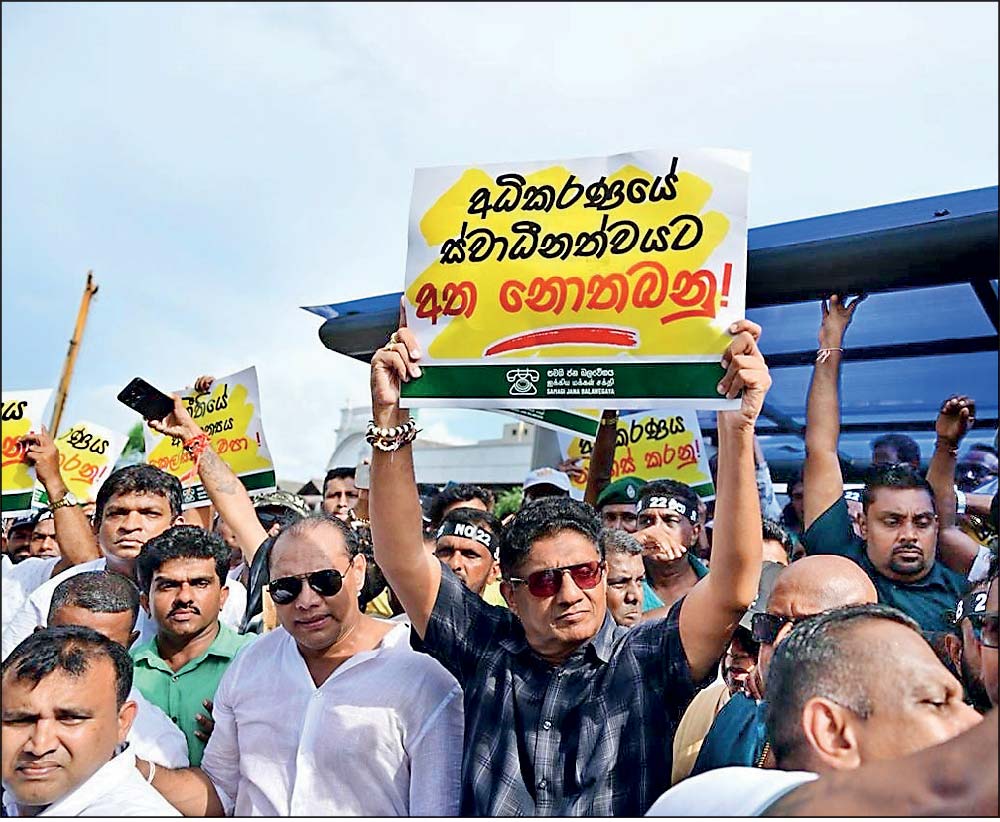
Opposition parties have used the courtroom drama to fuel street protests. The Samagi Jana Balawegaya (SJB), Sri Lanka’s main opposition party, staged a demonstration in Colombo Fort. Opposition Leader Sajith Premadasa led the protest in person. He promised his party would fight the amendment through every democratic channel available.
Critics also question the ruling NPP government’s broader record. The party won its 2024 election on a promise to write a brand-new constitution and scrap the executive presidency altogether. Two years later, that promise remains unfulfilled. Meanwhile, the government has pushed hard for judicial reform instead. This contrast has become a favorite talking point for opposition politicians.
Tamil political parties have raised a separate concern. The NPP promised provincial council elections within one year of taking office. Those elections still have not happened. The Northern and Eastern Provincial Councils remain without elected members. Some analysts argue this unfulfilled promise deserves more public attention than it currently gets.
What Happens Next
Parliament has scheduled debate on the 22nd Amendment for two full days. The first session runs from 10:30 a.m. to 5:00 p.m. The second session covers 9:30 a.m. to 5:00 p.m. the following day. Lawmakers will vote after this debate closes.
The real turning point, though, rests with the Supreme Court’s confidential determination. If judges rule that the Bill touches entrenched constitutional provisions, the government must hold a national referendum. If judges rule otherwise, a simple two-thirds parliamentary majority can pass the Bill into law.
The government holds more than the two-thirds majority needed to pass ordinary legislation. A referendum, however, would put the decision directly in voters’ hands. Recent surveys suggest public support for the government has slipped in recent months. This makes a referendum a riskier path for the ruling party.
Whatever the Court decides, the 22nd Amendment has already changed the national conversation. It has pulled international rights bodies into a domestic legal fight. It has tested how far Sri Lanka’s courts will go to rule on cases that affect the courts themselves. And it has forced citizens to ask a hard question: does keeping experienced judges on the bench protect justice, or does it quietly bend the system toward political convenience? The coming weeks will bring that answer into sharp focus.