How did police track down Ishara Sewwandi in Nepal? Inside the international manhunt that caught the mastermind behind Ganemulla Sanjeewa’s murder. Exclusive details here!
How Sri Lankan Police Tracked Down the Mastermind Behind Ganemulla Sanjeewa’s Murder After 8 Months on the Run
Colombo, Sri Lanka – In a dramatic conclusion to an eight-month international manhunt, Sri Lankan authorities successfully captured and extradited Ishara Sewwandi, the alleged mastermind behind one of the most shocking crimes in recent Sri Lankan history. The 25-year-old woman, who disguised herself as a lawyer to smuggle a weapon into a courthouse, was arrested in Nepal on October 14, 2025, and brought back to Sri Lanka the following day to face justice.
The Shocking Crime That Stunned a Nation
On February 19, 2025, the Hulftsdorp Magistrate’s Court in Colombo became the scene of an unprecedented assassination. Sanjeewa Kumara Samararatne, known in the criminal underworld as “Ganemulla Sanjeewa,” was shot dead inside Courtroom Number 5 while attending a hearing. The brazen attack sent shockwaves through Sri Lanka’s legal community and exposed the dangerous reach of organized crime networks.
What made this crime particularly alarming was how it happened. The gunman entered the high-security courthouse disguised as a lawyer, carrying a deadly weapon concealed inside what appeared to be an ordinary law book. This sophisticated operation required careful planning, inside knowledge, and someone willing to take enormous risks.
That someone, according to police investigators, was Ishara Sewwandi.
The Woman Behind the Murder Plot
Ishara Sewwandi, whose full name is Pingpura Dewage Ishara Sewwandi, played a crucial role in the assassination. Police investigations revealed that she also dressed as a lawyer to gain entry into the courthouse complex on that fateful morning. Hidden within a book she carried was a revolver that would soon end Ganemulla Sanjeewa’s life.
Once inside the courthouse, Sewwandi allegedly passed the concealed weapon to the actual gunman. Minutes later, shots rang out in the courtroom. Ganemulla Sanjeewa fell dead, and chaos erupted throughout the building.
While police quickly arrested the shooter, identified as Samindu Dilshan, Sewwandi vanished into thin air. She fled the courthouse immediately after handing over the weapon, beginning a journey that would take her across international borders and into hiding for nearly eight months.
Who Was Ganemulla Sanjeewa?
To understand why this murder happened, we need to know about the victim. Ganemulla Sanjeewa was not an ordinary citizen facing court proceedings. He was a well-known figure in Sri Lanka’s criminal underworld, allegedly involved in organized crime and drug trafficking operations.
His presence at the courthouse that day was part of ongoing legal proceedings against him. However, his enemies had decided that Sanjeewa would never see the end of his trial. The murder inside the courtroom was a calculated move by rival criminal networks seeking to eliminate a powerful competitor.
The Mastermind: Kehelbaddara Padme
Behind the entire operation stood an even more powerful figure: Manidunu Padmasiri Perera, better known as “Kehelbaddara Padme.” This notorious organized crime leader had ordered the hit on Ganemulla Sanjeewa, and Ishara Sewwandi was executing his plan.
Kehelbaddara Padme himself was arrested in Jakarta, Indonesia, on August 27, 2025, along with four other underworld figures: Panadura Nilanga, Commando Salintha, Backhoe Saman, and Thambili Lahiru. They were living in a residential complex in the Ebon Jeruk area of West Jakarta when Sri Lankan police, working with Indonesian authorities, apprehended them.
The capture of Kehelbaddara Padme proved to be the key that unlocked the mystery of Ishara Sewwandi’s whereabouts. During intense interrogations, the crime boss and his associates revealed crucial information about Sewwandi’s escape route and hiding places.
Three Months in the Shadows: Sewwandi’s Life Underground
After fleeing the courthouse, Ishara Sewwandi didn’t immediately leave Sri Lanka. Instead, she went underground, moving between safe houses in different parts of the country. Her confession to police later revealed the details of her desperate months in hiding.
For more than six weeks, Sewwandi stayed in Matugama, a town in the Kalutara District. She then moved to Matara in the southern province, constantly changing locations to avoid detection. The nationwide manhunt involved the Colombo Crimes Division, the Special Task Force, and numerous other security agencies, but Sewwandi managed to stay one step ahead.
During this time, she relied on a network of accomplices who provided shelter, food, and transportation. One key figure in her escape was Kennedy Bastian Pillai, known by his alias “J.K. Bai” or “J.K. Bhai.” This Jaffna-based associate would become instrumental in helping Sewwandi flee the country.
The Dangerous Journey Across Borders
After nearly three months of hiding within Sri Lanka, Sewwandi decided to leave the country. With J.K. Bai’s help, she made a risky journey that would take her thousands of miles from home.
The escape began at Midiganiya, where she and her accomplice prepared for the dangerous sea crossing. They traveled by boat from Sri Lanka to India, a perilous journey across international waters. The small vessel carried them across the narrow strait that separates the two countries, avoiding official border checkpoints and immigration controls.
Once in India, Sewwandi stayed for three days, lying low while her network arranged the next phase of her escape. She then traveled by train through India, heading north toward the Himalayan region. Her final destination was Nepal, a country where she hoped to disappear completely.
The entire operation cost approximately Rs. 6.5 million (around £17,000), with J.K. Bai financing her food, accommodation, and travel expenses. This massive sum showed how seriously the criminal network took the need to keep Sewwandi hidden from authorities.
Hidden in the Himalayas: Life in Nepal
In Nepal, Ishara Sewwandi settled into a carefully chosen hiding place approximately 18 kilometers from Kathmandu, the country’s capital. She rented a flat on the upper floor of a hillside building, living under a false identity and maintaining an extremely low profile.
Police reports indicate that Sewwandi lived in this location for several months, rarely venturing outside and depending on her accomplices for supplies and information. She believed that the distance from Sri Lanka and her false identity would keep her safe from capture.
However, Sewwandi wasn’t planning to stay in Nepal forever. Investigators discovered that she was preparing for yet another escape, this time to Europe. The plan involved using a forged passport prepared under the name of a Jaffna woman who resembled her. Visas had already been obtained for Dubai, India, and Nepal for both Sewwandi and her “dummy”—a woman whose identity she planned to assume.
This elaborate scheme showed the sophistication of the criminal network supporting her. It also demonstrated how far Sewwandi was willing to go to avoid arrest.
The International Operation: How Police Caught Her
While Ishara Sewwandi hid in Nepal, Sri Lankan police were building their case through painstaking detective work and international cooperation. The breakthrough came from an unexpected source: the interrogation of Kehelbaddara Padme and his associates after their arrest in Indonesia.
During questioning, one of the underworld figures revealed crucial information about Sewwandi’s location and her support network. This intelligence gave police the lead they desperately needed.
A specialized team from the Colombo Crimes Division, led by Assistant Superintendent of Police Rohan Olugala and Police Inspector Gihan Chandima, launched a cross-border operation in coordination with Nepalese law enforcement. The operation received support from Interpol, which had issued a Red Notice for Sewwandi’s arrest.
For three days, Sri Lankan and Nepalese officers conducted careful surveillance of the hillside residence where Sewwandi was hiding. They confirmed her presence and planned the raid meticulously to ensure a successful arrest without violence.
On Monday night, October 14, 2025, the international team moved in. Officers surrounded the building and approached the flat where Sewwandi was staying. When confronted by police, the fugitive offered no resistance.
According to police reports, Sewwandi told the arresting officers that she had expected to be caught “one day” by ASP Olugala. This statement suggested that despite her elaborate escape plans, she knew deep down that her time as a fugitive would eventually end.
Multiple Arrests in Nepal
Ishara Sewwandi wasn’t the only person arrested during the Nepal operation. Police took five other individuals into custody, all connected to organized crime networks or involved in helping Sewwandi evade capture.
The arrested suspects included:
- Kennedy Basthiyampillai (J.K. Bai) – The key accomplice who helped Sewwandi escape from Sri Lanka and financed her time in hiding
- Jeevadasan Kanakarasa – Connected to underworld activities
- Takshi Nandakumara – Also known as “Takshi,” linked to criminal networks
- Dinesh Shyamantha de Silva – From Nugegoda, involved in organized crime
- Wickrama Arachchige Dinesh Nishantha Kumara – Also known as “Gampaha Baba,” connected to drug trafficking
Additionally, police arrested a couple from Jaffna who had provided shelter to Sewwandi during her time in hiding. The woman who was supposed to serve as Sewwandi’s “dummy” for the forged passport operation was also taken into custody.
These multiple arrests showed the extensive network that had supported Sewwandi’s escape and revealed the complex web of organized crime operating across international borders.
Advanced Technology Cracked the Case
Modern technology played a crucial role in identifying and tracking Ishara Sewwandi. Police Spokesman SSP F.U. Wootler revealed that the Criminal Investigation Department used advanced computer technology and special intelligence information to locate the suspect.
Most significantly, authorities employed facial recognition technology to confirm Sewwandi’s identity with 100% accuracy. This cutting-edge system compared images of the suspect in Nepal with photographs from Sri Lanka, eliminating any doubt about whether they had found the right person.
The successful use of this technology highlights how law enforcement agencies are adapting to the challenges of tracking international criminals. In an era where fugitives can easily cross borders and assume false identities, biometric technology provides a powerful tool for police worldwide.
The Journey Home: Extradition to Sri Lanka
After the arrests in Nepal, Sri Lankan authorities moved quickly to bring the suspects back home. Two Special Task Force officers traveled to Nepal on October 14 to assist the Criminal Investigation Department with the extradition process.
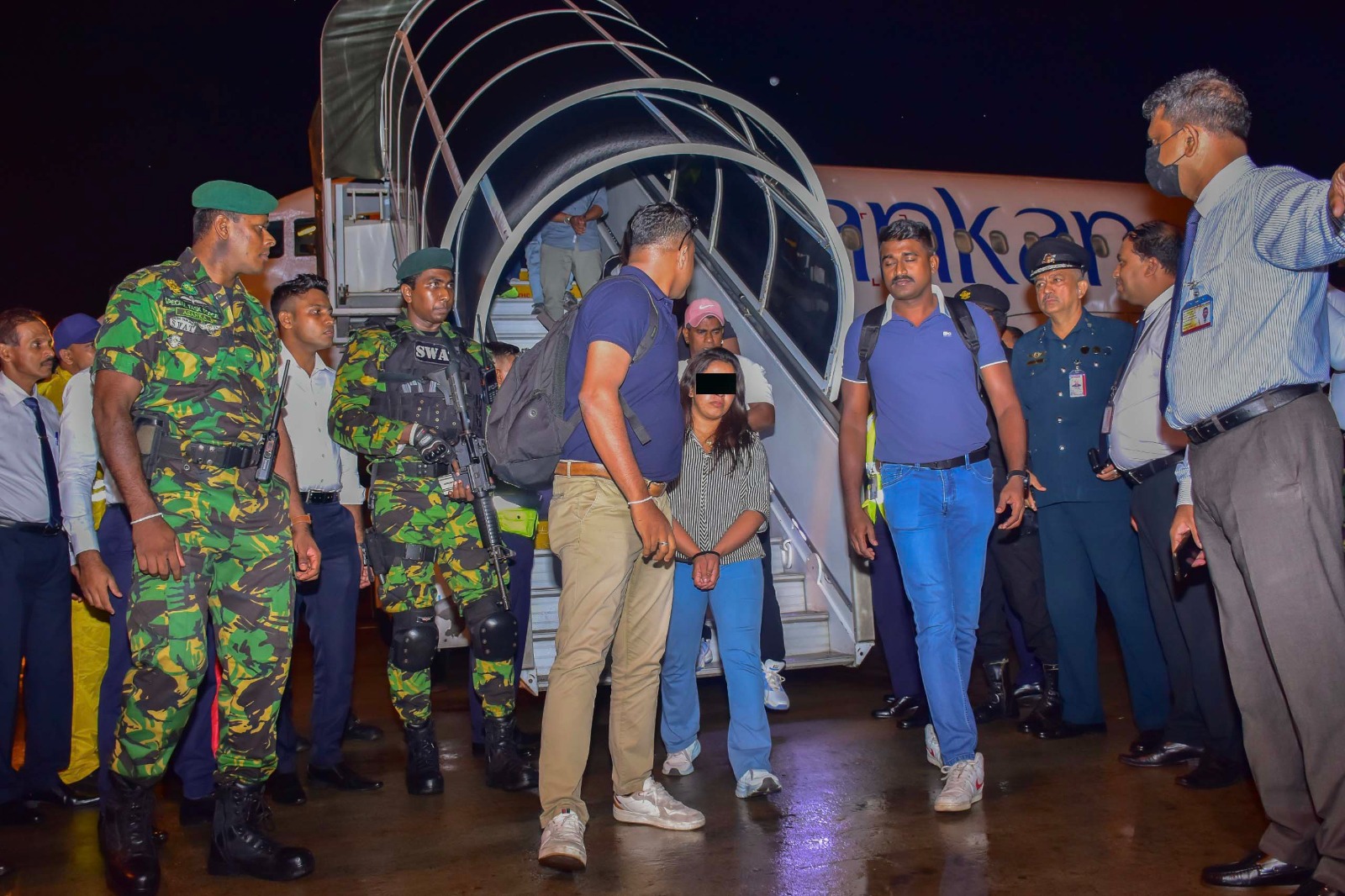
The following day, October 15, 2025, Ishara Sewwandi and the five other arrested suspects boarded UL Flight 182 in Kathmandu. The aircraft departed at approximately 3:30 p.m. Sri Lankan time, beginning the journey that would bring the fugitive back to face justice.
At 6:54 p.m., the plane touched down at Bandaranaike International Airport in Colombo. News media representatives and law enforcement officials were present as the suspects disembarked. The moment marked the end of Sewwandi’s eight months as an international fugitive.
From the airport, the suspects were taken directly into custody. Ishara Sewwandi, along with J.K. Bai, and two others known as Suresh and Takshi, were handed over to the Colombo Crimes Division for intensive questioning. The remaining suspects were transferred to other units: Gampaha Baba went to the Peliyagoda Range Crimes Division, while Jambugasmulle Babi was sent to the Western Province South Crimes Division.
What Comes Next: Legal Proceedings
Now back in Sri Lanka, Ishara Sewwandi faces serious charges related to the murder of Ganemulla Sanjeewa. As the alleged mastermind who provided the murder weapon and facilitated the assassination, she could face severe penalties under Sri Lankan law.
The Colombo Crimes Division is conducting thorough interrogations to understand the full extent of the conspiracy. Investigators want to know:
- Who else was involved in planning the murder?
- How did Sewwandi obtain the weapon?
- What was her exact relationship with Kehelbaddara Padme?
- Did she participate in other criminal activities?
- Who else helped her escape Sri Lanka?
These investigations will likely take weeks or months to complete. Additional arrests are expected as police uncover more details about the criminal network that supported both the murder and Sewwandi’s escape.
A Pattern of Cross-Border Crime Fighting
The successful arrest of Ishara Sewwandi represents the second major international operation conducted by Sri Lankan police in 2025. The earlier capture of Kehelbaddara Padme and four associates in Indonesia demonstrated the country’s commitment to pursuing criminals across borders.
According to Police Spokesman ASP Wootler, Sri Lankan authorities have issued approximately 40 Red Notices through Interpol for fugitive organized crime figures in 2025 alone. Of these, 18 wanted suspects have been successfully arrested and brought back to Sri Lanka.
These statistics reveal the scale of Sri Lanka’s organized crime problem and the international dimensions of criminal networks operating in the region. They also show that law enforcement agencies are becoming increasingly effective at tracking and capturing fugitives who flee abroad.
International Cooperation: The Key to Success
The Ishara Sewwandi case highlights the critical importance of international law enforcement cooperation. The operation involved multiple agencies across three countries:
Sri Lankan Agencies:
- Criminal Investigation Department (CID)
- Colombo Crimes Division (CCD)
- Special Task Force (STF)
- Various intelligence units
International Partners:
- Nepal Police
- Interpol
- Indonesian authorities (in the earlier Kehelbaddara Padme operation)
This collaborative approach allowed authorities to share intelligence, coordinate operations, and ensure that fugitives had nowhere to hide. The use of Interpol Red Notices alerted law enforcement worldwide to watch for Sewwandi, making it nearly impossible for her to move freely between countries.
Impact on Organized Crime Networks
The arrest of Ishara Sewwandi, combined with the earlier capture of Kehelbaddara Padme and his associates, deals a significant blow to organized crime networks in Sri Lanka. These networks have long operated with relative impunity, engaging in drug trafficking, contract killings, and other serious crimes.
However, the successful international operations send a clear message: there is no safe haven for criminals, no matter how far they run. This may discourage other underworld figures from believing they can escape justice by fleeing the country.
The operations also expose the vulnerability of criminal networks that depend on international connections. When one member is captured and interrogated, they often provide information that leads to additional arrests, creating a domino effect that can dismantle entire criminal organizations.
Lessons for the Public
The Ishara Sewwandi case offers several important lessons for ordinary citizens:
1. Security Challenges: The fact that weapons could be smuggled into a courthouse reveals serious security vulnerabilities. This incident has likely prompted reviews of security procedures at court complexes and other sensitive locations.
2. Criminal Networks: Organized crime is not just about stereotypical gangsters. Sewwandi’s case shows that criminals can be young, seemingly ordinary people who commit extraordinary acts of violence.
3. International Dimensions: Crime is increasingly transnational. Criminals use international borders to evade capture, requiring cooperation between countries to bring them to justice.
4. Technology’s Role: Modern law enforcement relies heavily on technology, from facial recognition systems to international databases like Interpol’s Red Notice system.
5. Justice Takes Time: Eight months passed between the crime and Sewwandi’s arrest, but persistence paid off. The legal process will likely take much longer, but authorities remained committed to finding her.
The Broader Picture: Crime in Sri Lanka
The assassination of Ganemulla Sanjeewa and the subsequent manhunt for Ishara Sewwandi occur against a backdrop of ongoing concerns about organized crime in Sri Lanka. Drug trafficking, contract killings, and gang violence have become increasingly sophisticated challenges for law enforcement.
Several factors contribute to this situation:
- Drug Trafficking Routes: Sri Lanka’s geographic position makes it a transit point for international drug smuggling operations.
- Criminal Networks: Organized crime groups have established connections across borders, making them harder to combat.
- Corruption: Criminal networks often attempt to corrupt officials, weakening law enforcement efforts.
- Economic Factors: Economic challenges can push vulnerable individuals toward criminal activities.
However, the successful international operations in 2025 demonstrate that Sri Lankan authorities are adapting to these challenges. By working with international partners and using modern technology, they are becoming more effective at fighting organized crime.
Public Reaction and Media Coverage
The arrest of Ishara Sewwandi generated intense media coverage and public interest in Sri Lanka. Many people followed the story from the initial courthouse assassination through the months of searching to the final arrest in Nepal.
Public reaction has been mixed. Some celebrate the successful police work and international cooperation that led to Sewwandi’s capture. Others express concern about the security failures that allowed such a brazen crime to occur in the first place.
The case has also sparked discussions about women’s roles in organized crime. While criminal networks have traditionally been male-dominated, Sewwandi’s alleged central role in planning and executing the murder challenges these assumptions.
What Happens to the Other Suspects?
While Ishara Sewwandi has received the most media attention, the other suspects arrested in Nepal also face serious charges. J.K. Bai, in particular, could face charges related to helping a fugitive escape justice and providing financial support for her time in hiding.
The suspects connected to drug trafficking and other organized crime activities will be investigated separately for their alleged crimes. Some may become cooperating witnesses, providing information about criminal networks in exchange for reduced sentences.
The couple from Jaffna who provided shelter to Sewwandi will likely face charges related to harboring a fugitive. The woman who agreed to serve as Sewwandi’s “dummy” for the passport fraud scheme could face identity fraud charges.
Conclusion: A Victory for Justice, But More Work Ahead
The successful arrest and extradition of Ishara Sewwandi represents a significant victory for Sri Lankan law enforcement. It demonstrates that even sophisticated criminals who flee across international borders can be tracked down and brought to justice.
However, this case is far from over. The legal proceedings will likely continue for months or years as prosecutors build their case and the accused have their day in court. Additional investigations may reveal more members of the criminal network who helped plan the murder or assisted Sewwandi’s escape.
More broadly, the fight against organized crime continues. While the capture of major figures like Kehelbaddara Padme and Ishara Sewwandi weakens criminal networks, other criminals will attempt to fill the void. Law enforcement agencies must remain vigilant and continue working with international partners to combat these threats.
For now, though, the people of Sri Lanka can take some comfort in knowing that even the most carefully planned crimes and elaborate escape attempts cannot guarantee impunity. The wheels of justice may turn slowly, but they do turn. Ishara Sewwandi, once a fugitive hiding in the Himalayas, now sits in a Sri Lankan detention facility awaiting trial—a powerful reminder that justice has a long reach and a long memory.

Salute to Sri Lanka Police 🇱🇰
Great job by the Sri Lanka Police for arresting Ishara Sewwandi, who was wanted for the shooting of underworld figure Sanjeewa Kumara Samararatne.
Big respect to ASP Rohan Olugala, CI Upul Rathnayaka, IP Gihan de Silva, and PC Chamara Lakmal pic.twitter.com/Y2G8i4Ge9L— Chatura Alwis (@chaturaalwis) October 16, 2025
The six Sri Lankans arrested in Nepal, including Ishara Sewwandi, a suspect in the killing of Ganemulla Sanjeewa, brought back to Sri Lanka.
Ishara Sewwandi is to be handed over to the Colombo Crimes Divisionpic.twitter.com/eehD2pOsbf— Sri Lanka Tweet 🇱🇰 (@SriLankaTweet) October 15, 2025