8 years of controversy. 4 investigations. 1 presidential order. How Shammi Silva was finally bowled out of Sri Lanka Cricket.
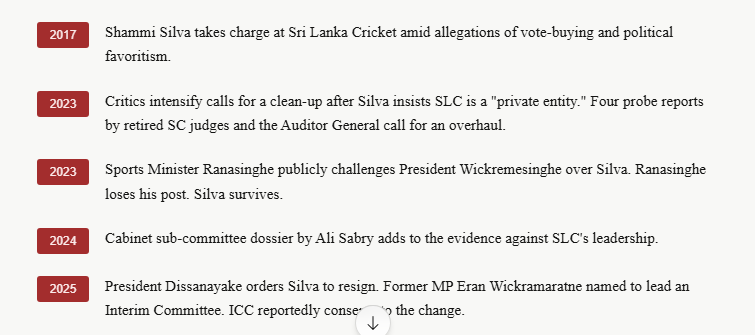
President Anura Kumara Dissanayake has finally ordered Sri Lanka Cricket chief Shammi Silva to resign, ending nearly eight years of alleged corruption, nepotism, and unchecked power that shook the island’s most-loved sport to its core.
Cricket lovers across Sri Lanka woke up to a piece of news on April 22 that many had stopped hoping for. Shammi Silva, the man who treated Sri Lanka Cricket (SLC) as his personal kingdom for close to eight years, has been told by President Anura Kumara Dissanayake to pack his bags. The days of backroom deals, alleged vote-buying, and iron-fisted control over the country’s most popular sport appear, at long last, to be numbered.
For millions of fans who fill stadiums in Galle, Colombo, and Kandy, cricket is not just a game — it is a religion. Yet the institution meant to protect and grow that passion had, according to numerous independent reports, become a breeding ground for financial mismanagement, nepotism, and political manipulation. The man at the center of all that chaos was Shammi Silva, and his reign is now coming to a close.
Who is Shammi Silva and why does his exit matter?
Shammi Silva rose to lead Sri Lanka Cricket on a wave of political connections and, critics say, alleged vote-buying tactics that allowed him to stay in power long after his welcome had expired. He held the position for nearly eight years — an extraordinarily long run in a role that many believe should have changed hands multiple times during that period.
Under his watch, SLC became what observers described as the best place outside the office of the Head of State. That is not a compliment. It is a reference to the enormous power, resources, and patronage that the position offered, and how Silva allegedly used all three to silence rivals, reward loyalists, and keep himself firmly in the driving seat.
Silva was not shy about defending his position in public. He repeatedly argued at press conferences that SLC was a private entity — funded by the International Cricket Council, team participation money from World Cups, and major corporate sponsorships. Critics rejected this view loudly, insisting that an institution of that size and national significance is a public body that must be held accountable to the people of Sri Lanka.
“Former Sports Minister Roshan Ranasinghe famously forced a showdown — and it was Ranasinghe who became the fall guy.”
A political showdown that Silva won — until now
The storm over Silva’s leadership did not arrive overnight. It built over years, gathering strength each time a new scandal surfaced or a report landed on a minister’s desk. One of the most dramatic moments came inside Parliament itself, where former Sports Minister Roshan Ranasinghe confronted the situation head-on. He famously challenged President Ranil Wickremesinghe to choose between him — the minister — and a tainted SLC chief.
It was a bold move, and it backfired. President Wickremesinghe stood by Silva. Ranasinghe lost his position. Silva walked away unscathed, and the message was clear to anyone watching: political protection, not performance or integrity, was what kept a person in power at SLC. That moment left a deep scar on the credibility of the administration and raised serious questions about accountability in Sri Lankan public life.
Even President Dissanayake — who ran on an election platform built around cleaning up public institutions — drew sharp criticism for what many saw as a hypocritical delay in acting against Silva. Voters who believed in his promise of a corruption-free administration repeatedly asked why the SLC chief still held his post months after the new government took office. That pressure, combined with calls from players themselves, has apparently now become impossible to ignore.
Four investigations, one damning verdict
The case against Shammi Silva’s administration did not rely on rumors or opposition spin. It rested on a paper trail that grew thicker with each passing year. Four separate investigative and probe reports — compiled by retired Supreme Court judges and the Auditor General of Sri Lanka — all pointed in the same direction. They called for a fundamental overhaul of SLC, citing financial mismanagement, nepotism, and the concentration of power in too few hands.
Those findings were then followed by a Cabinet sub-committee dossier compiled by former Justice Minister Ali Sabry. The dossier added further weight to the argument that SLC under Silva had drifted dangerously far from the standards expected of a major national institution.
Together, these documents represent one of the most thorough recorded cases for institutional reform in Sri Lankan sporting history. The question was never whether the evidence existed. The question was whether the political will to act on it ever would.
Eran Wickramaratne steps in — who is he?
The Daily Mirror exclusively reports that former Member of Parliament Eran Wickramaratne will head an Interim Committee to manage SLC while a longer-term solution is worked out. Wickramaratne brings a background that is both politically credible and personally connected to cricket — he is a former Royal College cricketer, a school with one of the proudest cricket traditions in the country.
His appointment signals that the new administration wants someone who understands the sport’s culture and administration, while also being able to command enough political respect to manage the transition smoothly. Whether he can deliver meaningful reform in the short time an interim committee typically holds office remains the key question that supporters of clean governance are asking.
For the appointment to mean anything beyond a change of faces, the Interim Committee will need to begin addressing the structural failures that the four probe reports identified, restore transparency in financial dealings, and create conditions for fresh elections at SLC that are genuinely free from political interference.
The ICC factor: global cricket’s quiet consent
One of the most significant developments in this story involves the International Cricket Council. A senior Cabinet minister reportedly conveyed to the ICC that the change in SLC leadership was an internal Sri Lankan matter, and the global governing body of cricket is said to have consented to that position.
This is important because the ICC has previously suspended national cricket boards that it considered to be subject to undue government interference — a designation that can cut off funding and bar teams from international competitions. The fact that the ICC accepted this change as an internal matter, rather than treating it as political interference, provides the Dissanayake government with the international legitimacy it needs to proceed without fear of sanctions.
It also raises a broader question worth examining: what exactly constitutes legitimate government oversight of a national cricket body, versus interference that violates ICC rules? The line is blurry, and Sri Lanka’s handling of this transition will be watched closely by other member nations dealing with similar tensions between sporting autonomy and government accountability.
What happens next: accountability beyond the exit
Shammi Silva has not gone quietly. He asked President Dissanayake for one week before stepping out to face the wider public. That request suggests he knows the questions waiting for him are not comfortable ones. With his immunity as SLC chief gone, he now faces potential scrutiny over the financial decisions, contractual arrangements, and governance choices that four independent reports found troubling.
Anti-corruption advocates insist that removing Silva from power is only the first step. They want accountability — not just a clean-up of the present, but a reckoning with the past. Legal proceedings, financial audits, and formal investigations may now move forward more freely without the political protection that kept them stalled for so long.
Players, too, are watching. The fact that members of the national team reportedly joined public voices calling for Silva’s resignation is a striking sign of how deep the frustration had run. Athletes rarely speak out against administrators — the career risks are real. That they did so in this case speaks to the level of dysfunction that had apparently taken hold within SLC.