Sri Lanka fuel price increase hits midnight May 2 — Petrol 92 rises to Rs.410, Diesel to Rs.392. Full price table, school van impact, and what changes for you today.
Ceylon Petroleum Corporation raises petrol, diesel, and kerosene from midnight Saturday. Lanka IOC follows within hours. School van operators announce fee hikes from Monday. Here is the complete breakdown — every rupee, every fuel type, every ripple effect.
Picture this: it is just past midnight on Saturday, May 3. Most of Sri Lanka is asleep. But at fuel stations from Jaffna to Galle, a quiet but consequential change takes effect. The Ceylon Petroleum Corporation (CPC), the state oil giant that supplies fuel to millions of Sri Lankans every day, flips the price board. Every single fuel type goes up. For many ordinary families, the impact will not wait until morning — it will show up in the school van receipt on Monday, in the three-wheeler fare to the office, and eventually in the price of every tomato and loaf of bread that travels to market by truck.
This is not a rumour or a proposal. The CPC has confirmed the revision. Lanka Indian Oil Company (Lanka IOC), the private fuel retailer, has already matched the hike for its two products. The numbers are in, and the ripple effects have already begun.
What Exactly Changed — and by How Much?
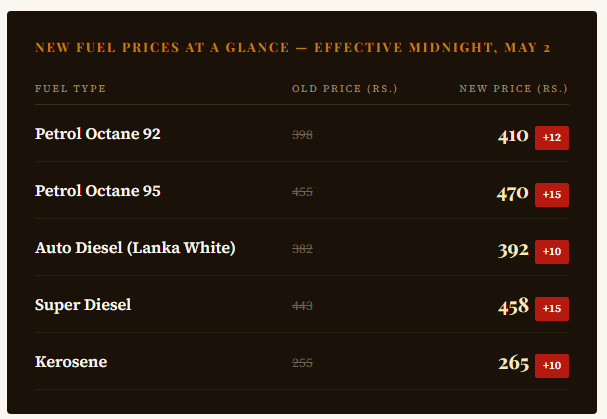
The CPC increased the price of all five fuel categories it sells. Let us go through each one clearly, because these numbers directly shape daily life in Sri Lanka.
Auto Diesel — the fuel that powers most buses, lorries, school vans, and delivery trucks — climbed by Rs. 10, landing at Rs. 392 per litre. That may sound modest on paper, but a school van covering 80 kilometres a day drinks roughly 10 to 12 litres of diesel. That is Rs. 100 to Rs. 120 more per day, every working day.
Petrol Octane 92, the most widely used grade among personal car and motorbike owners, increased by Rs. 12 to reach Rs. 410 per litre. For a small car with a 40-litre tank, a full fill now costs Rs. 480 more than last week. Over a month of regular commuting, that adds up to roughly Rs. 2,000 or more in extra spending.
Petrol Octane 95 and Super Diesel each rose by Rs. 15 — the steepest hike in this revision. Octane 95 now stands at Rs. 470 per litre, while Super Diesel reaches Rs. 458. These fuels power premium vehicles and heavy commercial transport respectively. Kerosene, which remains the cooking and lighting fuel for lower-income households and rural communities, went up by Rs. 10 to Rs. 265 per litre.
Lanka IOC Follows — Two Fuels, Same New Prices
Within hours of the CPC announcement, Lanka Indian Oil Company confirmed it would match the revision — but only for the two fuel types it sells: Lanka Auto Diesel and Petrol 92. Both now cost the same at IOC pumps as they do at Ceypetco stations: Rs. 392 for auto diesel and Rs. 410 for Petrol 92.
Lanka IOC stated clearly that it would not change prices for any other products at this time. The company’s decision to align with CPC keeps the playing field level for consumers — there is no longer any price advantage from driving to an IOC station over a CPC one for these two fuels.
This simultaneous revision matters because Lanka IOC holds a significant share of the retail fuel market in Sri Lanka, particularly in the Western and Southern provinces. When both suppliers raise prices together, consumers have no alternative pump to turn to for cheaper fuel.
School Vans Go Up From Today — What Parents Need to Know
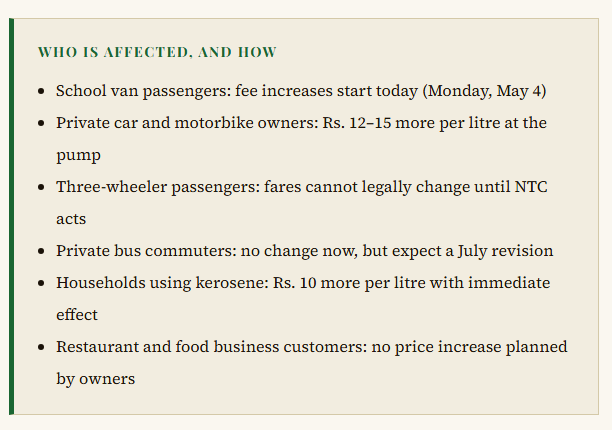
For thousands of parents who rely on school transport services, Monday, May 4 marks the start of a more expensive routine. The All Ceylon School Children’s Transport Association announced that member drivers will increase fees starting today — and they did not wait for anyone’s permission to do so.
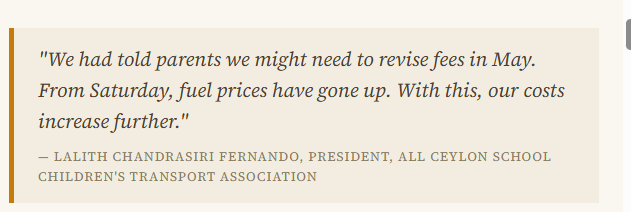
Association President Lalith Chandrasiri Fernando said that parents had already been put on notice about a possible May revision. He was careful to point out, however, that there is no single percentage increase being enforced across the country. Instead, each driver in each area will calculate their own cost increase based on diesel consumption and route distance, then pass on only what is necessary.
“It is not fair to apply a uniform percentage across the country,” Fernando said. “Drivers in each area will decide the revision based on their costs.”
This means parents should expect a phone call or WhatsApp message from their van driver this week — and the increase could range from a few hundred rupees to over a thousand rupees per month depending on distance travelled.
Bus Fares — Not Yet, But July Is Coming
If you take a private bus to work, you can breathe for now. The Lanka Private Bus Owners’ Association (LPBOA) has confirmed there will be no immediate increase in bus fares following this price revision. LPBOA President Gemunu Wijeratne stated that the additional fuel cost will instead be absorbed until the scheduled annual fare revision on July 1.
That is a two-month window — but it also signals that a July fare increase is now virtually guaranteed, and the cumulative effect of this fuel hike will almost certainly be factored in. Commuters who depend on private intercity routes should plan for higher fares from July onwards.
The Inter-Provincial Private Bus Association did not respond to press queries, so the picture for long-distance routes remains unclear at the time of writing.
Three-Wheelers: Drivers Want Relief, But Rules Bind Their Hands
Three-wheeler drivers face a difficult situation that goes beyond simple economics. Lalith Dharmasekara, President of the All Island Three-Wheeler Drivers’ Association, acknowledged that a fare increase is both necessary and justified given the rising cost of petrol. But he pointed to a structural problem: legally, neither individual drivers nor their associations can raise three-wheeler fares.
The authority to regulate three-wheeler charges belongs to the National Transport Commission (NTC). However, a proper and functioning mechanism for NTC to actually revise these fares has yet to be put in place. This leaves drivers stuck between rising costs they cannot avoid and charges they cannot legally increase.
In practical terms, this means many three-wheeler drivers will quietly start asking for more money and hope passengers do not complain — a grey area that benefits no one and creates friction on every ride. The absence of a clear regulatory process is a policy failure that this fuel hike has once again exposed.
Food Prices — The Industry Says Hold the Line
One sector where the public can take comfort — at least for now — is food and beverages. Restaurant Owners’ Association President Harshana Rukshan made a clear public statement: his members will not increase food prices because of this fuel hike, and he is actively urging them not to.
“The fuel price has gone up by about Rs. 12 or Rs. 15,” Rukshan said. “That is not enough to justify increasing food and beverage prices. We cannot pass this cost on to consumers.” He also called on the Consumer Affairs Authority to take firm action against any restaurant or eatery that uses the fuel revision as a pretext for unjustified price increases.
This is an important signal. In past fuel revisions, food price increases often followed within days — driven more by opportunism than genuine cost pressures. The association’s early and public stance against such increases could help suppress that pattern this time around.
Why Did Prices Go Up? The Bigger Picture
Sri Lanka imports virtually all of the fuel it uses. The country purchases refined petroleum products primarily from Singapore, Malaysia, and South Korea, and depends on Middle Eastern crude for its Sapugaskanda refinery. Global oil markets remain sensitive to geopolitical pressures, and any disruption to supply routes translates almost immediately into higher import costs for an island nation with limited fuel storage capacity and foreign exchange reserves that are still rebuilding after the 2022 economic crisis.
The CPC, as the state oil company, operates under the government’s pricing formula. When import costs rise beyond a sustainable threshold, a retail price revision becomes unavoidable. The alternative — absorbing losses at the state company — creates the kind of hidden debt that contributed to the 2022 collapse in the first place.
The IMF programme that Sri Lanka operates under requires greater cost-reflective pricing of energy. In this context, the revision is not a surprise to economists or policymakers — but that does not make it easier for the millions of Sri Lankans who will feel it in their pockets this week.
What Consumers Can Do Right Now
Understanding the revision is the first step toward managing it. If you drive a petrol vehicle, consider checking your driving habits: reducing highway speed, minimising idling, and keeping tyres properly inflated can meaningfully reduce fuel consumption. For diesel users, consolidating trips and planning routes more efficiently will help absorb the increased cost.
Parents who receive higher school van bills should ask for a written breakdown from the driver — not to dispute the increase, but to understand whether it is proportionate to the Rs. 10 rise in diesel. A well-informed parent is better positioned to have a fair conversation with their van driver.
If you use kerosene for cooking, this is a good time to explore whether a transition to LPG is financially viable over the medium term. While LPG carries its own price volatility, it tends to offer more cost efficiency per unit of energy.
For restaurant owners, the association’s guidance is clear: do not raise prices yet. Holding the line on food costs while the revision settles will build customer goodwill and is the economically responsible choice when the fuel cost increase is relatively small.
Fuel price changes in Sri Lanka are never just about numbers at the pump. They cascade through transport, food, manufacturing, and household budgets with a speed and scale that can outpace any individual’s ability to adapt. The midnight revision of May 2 is a significant one — not the largest in recent memory, but significant enough to matter to every Sri Lankan who commutes, cooks, or runs a small business.
The decisions made in the next few days by school van drivers, bus operators, three-wheeler regulators, and local businesses will determine whether this revision remains a manageable adjustment or becomes the first link in a chain of price increases that pushes ordinary households further toward the edge. Staying informed — and holding both regulators and businesses accountable — is the most powerful tool the public has.